Why You Shouldn't Hire a Junior Developer for Your Startup MVP
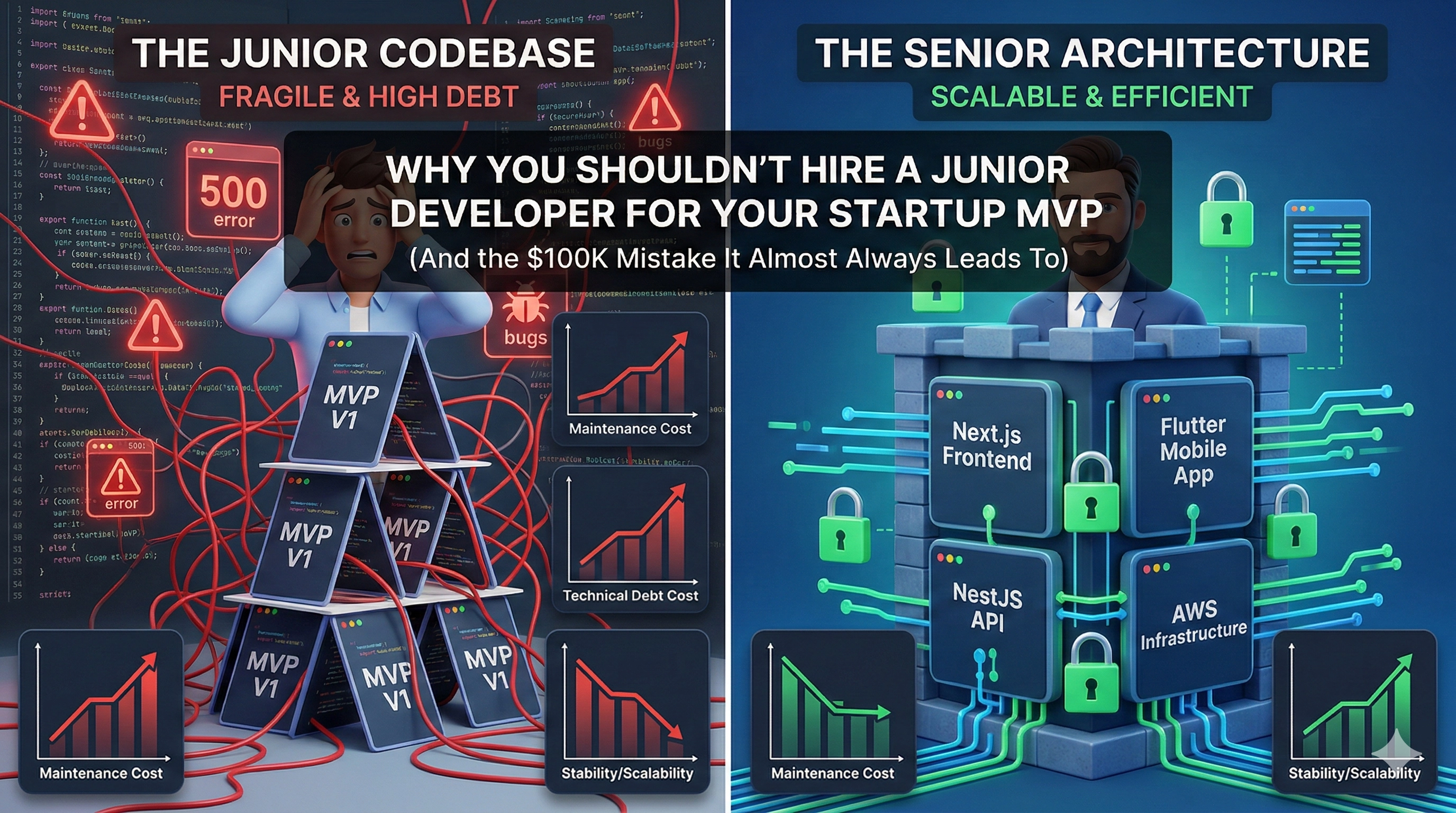
The founder’s dilemma is real. You have a vision, a tight bootstrapping budget, and a pressing need to get your Minimum Viable Product (MVP) live before your runway evaporates.
Every dollar counts. When you start looking for developers, hiring a junior on a freelance platform for $15–$25 an hour feels like a brilliant business hack. You tell yourself, “I just need something basic to prove the concept. I’ll hire a real senior architect once we secure funding.”
This is the Build Trap and it is one of the most common, expensive mistakes early-stage startups make.
As a Senior Software Engineer who has built more than 35 production-ready applications, I have seen this exact scenario play out dozens of times. While a junior developer can write code, they rarely possess the architectural foresight required to build a product that survives its own launch.
You are not saving money by hiring a junior developer for your MVP. You are simply delaying the cost and multiplying it later.
Here is the strategic reality: your MVP is your foundation. If you build your foundation on sand, it does not matter how strong your idea is. Eventually, the technology will collapse under its own weight.
Code vs. Architecture: The Real Difference
To understand why this decision is so risky, we need to distinguish between writing code and building a product.
A junior developer is focused on getting a feature to work in a single, ideal scenario. They follow tutorials and stitch together snippets from documentation and forums. That approach is fine for a hobby project.
But a successful commercial product requires a cohesive, scalable ecosystem.
A senior engineer does not just write code, they design architecture.
Here is how that difference plays out in real scenarios:
Authentication: A junior developer might focus on simply making email and password login work. A senior engineer thinks about secure password hashing, token refresh logic, role-based access control, and scalable OAuth from day one to prevent data breaches.
Database Setup: A junior may push data into a table just to confirm it appears correctly. A senior designs an optimal data model with proper relationships, indexing strategy, and query performance in mind, especially for when you reach 10,000+ users.
Cloud Infrastructure: A junior celebrates once the app is live on a basic server. A senior ensures the infrastructure is automated, secure, monitored, and capable of autoscaling during peak traffic.
Mobile App Foundation: A junior focuses on matching the Figma design visually. A senior ensures proper state management, caching, and offline handling so the app remains stable under real-world conditions.
When you hire a junior, you often get patchwork engineering, a collection of disconnected features that appear complete but fail the moment they encounter real users, edge cases, and growth.
The Hidden Costs of the “Cheap” MVP
If your junior-built product gains traction, you will quickly encounter compounding technical debt. Here is what typically happens next.
1. The Nightmare of Success
The hardest part is not failing, it is succeeding.
On launch day, a surge of traffic exposes every flaw. If your database is not properly indexed or your API layer is fragile, your application crashes. While you are losing users, credibility, and potential investors, your junior developer is scrambling to diagnose issues in a system that was never designed for scale.
2. The Slowdown in Velocity
At first, development feels fast. Features are shipped quickly.
But as complexity increases, the fragile foundation begins to show. What once took two days now takes two weeks because modifying one component unexpectedly breaks another. The codebase becomes tightly coupled and difficult to maintain.
Momentum, your most valuable startup asset, slows down.
3. The Forced Rewrite
Eventually, one of two things happens:
You attempt to raise funding and undergo technical due diligence.
You realize the product cannot scale or evolve further.
You bring in a senior architect to assess the situation. In most rescue scenarios, the conclusion is the same: a complete ground-up rewrite is the only viable path forward.
At this stage, you are paying premium rates to rebuild something you already paid to build once. Your “cheap” MVP becomes your single largest expense in time, money, and opportunity cost.
A Senior Partner Is an Investment, Not a Cost
A senior engineer is not just a developer. They are a strategic technical partner.
The goal is not simply to launch. The goal is to launch on a foundation that supports growth.
When you work with a senior professional, you invest in:
Speed to Reliability
Clean architecture from day one. Thoughtful stack selection. Production-grade patterns. Fewer critical bugs during launch. Stability when it matters most.
Future-Proofing
Modular systems designed for change. Clear separation of concerns. Scalable infrastructure. The ability to add features without breaking existing functionality.
Business Alignment
Real technical leadership means pushing back when necessary. It means advising you on the most cost-effective way to achieve your business goals — not blindly executing tickets.
Your MVP should be a launchpad, not a limitation.
The Bottom Line
Your MVP is the first impression your vision makes on users, on partners, and on investors.
Do not entrust your entire venture to someone who is still learning the fundamentals. The cost of inexperience is rarely visible at the beginning. It becomes painfully obvious later.
Build it right the first time.
Let’s Get Your MVP Right, From Day One
Do not build your startup on fragile architecture.
If you are preparing for a product launch, let’s have an honest conversation about the technical foundation your vision requires.
I offer a free 15-minute architectural consultation for founders. We will discuss your MVP goals, timeline, and the most strategic way to get you to market safely and sustainably.
👉 [https://calendly.com/shahzaibmazher1996/new-meeting]
📧 Or reach out directly: shahzaibmazher1996@gmail.com