AI Didn’t Replace You. It Showed the Gaps
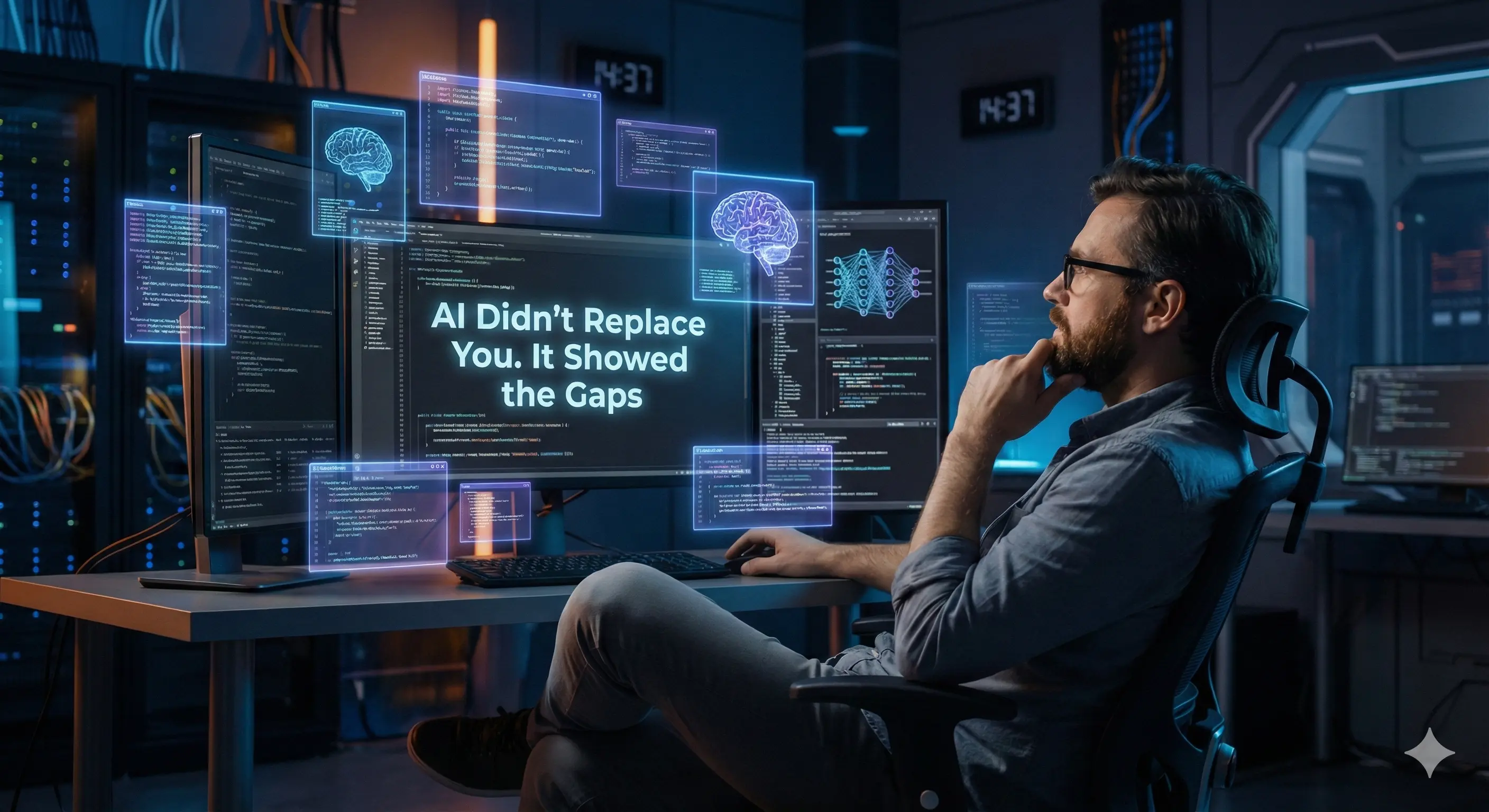
AI Makes Coding Easier, But Not Thinking
Tools like ChatGPT and Copilot can help write code faster and more efficiently than ever before. They can do things like:
Create basic APIs for common use cases
Generate repetitive code structures automatically
Add form validation and checks
Write SQL queries or ORM logic
Make configuration files for different environments
Create simple unit or integration test files
These tasks save time but don’t require deep problem-solving skills. AI can do them quickly, which is useful, but it cannot replace the thinking required to solve complex problems. Figuring out tricky bugs, understanding how multiple parts of a system interact, and handling unexpected failures are still tasks only humans can do well. Writing code is only one part of being a strong developer, understanding the systems behind the code is what really counts.
What AI Can Do
Follow Patterns: AI can make interfaces, controllers, and widgets by recognizing common patterns. It’s very good at applying patterns but doesn’t understand the bigger picture of your application.
Repetitive Work: AI can handle similar layers of code, like mapping data objects, setting up service layers, or creating standard CRUD operations. This eliminates repetitive typing and frees you to focus on higher-level tasks.
Standard Tasks: Login flows, caching setups, and basic validation rules are examples AI can handle efficiently. It has seen millions of examples and can produce code quickly.
Simple Debugging: AI can spot syntax mistakes, missing words, type errors, or basic query issues. This helps reduce obvious bugs, letting you focus on harder, less obvious problems.
In short, AI is strongest at tasks that are repetitive, structured, and predictable. the kind of work many less-experienced developers rely on daily.
What AI Cannot Do
Complex Debugging: Bugs that occur intermittently, memory leaks, race conditions, or performance bottlenecks require careful investigation, intuition, and experience. AI can suggest ideas, but diagnosing and fixing these issues needs a human touch.
Big Architecture Decisions: Choosing system designs, balancing speed and simplicity, planning for scalability, and considering long-term maintenance and risk require judgment. AI cannot meaningfully weigh these tradeoffs.
Performance Fixes: Optimizing speed, finding hidden inefficiencies, or handling large datasets requires measurement, testing, and iteration. AI can propose general improvements but cannot measure or validate the specific system you’re working on.
Business Decisions: Deciding which features deliver the most value, explaining risks to non-technical stakeholders, and ensuring software aligns with business goals are uniquely human tasks. AI can provide options but cannot make decisions for you.
AI can give suggestions, but responsibility for the results still falls on you.
Why Some Developers Struggle
Many developers have built careers on copying code, following tutorials, or relying heavily on frameworks without fully understanding why things work. That was often enough before. But now AI can replicate that work faster and more accurately than a human. If you depended on just executing steps, AI exposes that gap instantly. The most valuable skill now is understanding why the code works, how the system behaves, and what happens when things fail.
The New Skill Gap
Before AI, the difference between junior and senior developers was most obvious at higher levels. AI speeds up basic coding, making gaps visible earlier. The new gap isn’t about years of experience; it’s about understanding systems deeply versus just following steps mechanically. Developers who can reason through problems, anticipate issues, and design smart solutions are the ones who stand out.
Skills That Matter Now
Systems Thinking: Understand how different parts of a system connect and affect each other. Predict how a change in one component can impact the entire system.
Debugging Skills: Find problems, form hypotheses, test ideas, and fix issues methodically. Learn to use logs, profiling tools, and tracing effectively.
Architecture Reasoning: Make informed design choices that balance speed, simplicity, maintainability, and scalability. Think through tradeoffs rather than following trends blindly.
Clear Communication: Explain risks, clarify requirements, mentor teammates, and share knowledge. Good communication amplifies your impact and prevents mistakes.
Understanding Tradeoffs: Recognize that every choice has pros and cons. Decide based on context, not just rules, and justify your decisions to yourself and others.
Using AI Wisely
Use AI to save time on repetitive or predictable tasks. But always ask yourself:
Do I truly understand this code?
Can I explain it clearly to a teammate?
Are there hidden problems or edge cases?
If you can’t answer these, you don’t fully own the code, and AI has highlighted that. Treat AI as a tool to extend your abilities, not a replacement for understanding.
What This Means for Your Career
AI will reduce the need for typing repetitive code. But it increases the value of developers who can design systems, solve complex problems, and handle production issues. Software complexity isn’t going away, requirements will stay tricky, and systems will still break. The developers who succeed are those who can think clearly, anticipate problems, and make smart decisions consistently.
Investing in skills like debugging, architecture, communication, and understanding tradeoffs ensures your work remains valuable and resistant to automation.
A Wake-Up Call
AI isn’t here to shame you. It’s here to show you where you need to grow. Look at your weak spots and focus on improving systems thinking, debugging, architecture, tradeoff analysis, and communication. Treat it as a guide for leveling up.
Remember: you were hired to solve problems, not just write lines of code. AI didn’t replace you, it made it clear who understands their work and who doesn’t. Embrace this as a chance to become the kind of developer no tool can replace someone whose understanding and problem-solving skills make them indispensable.